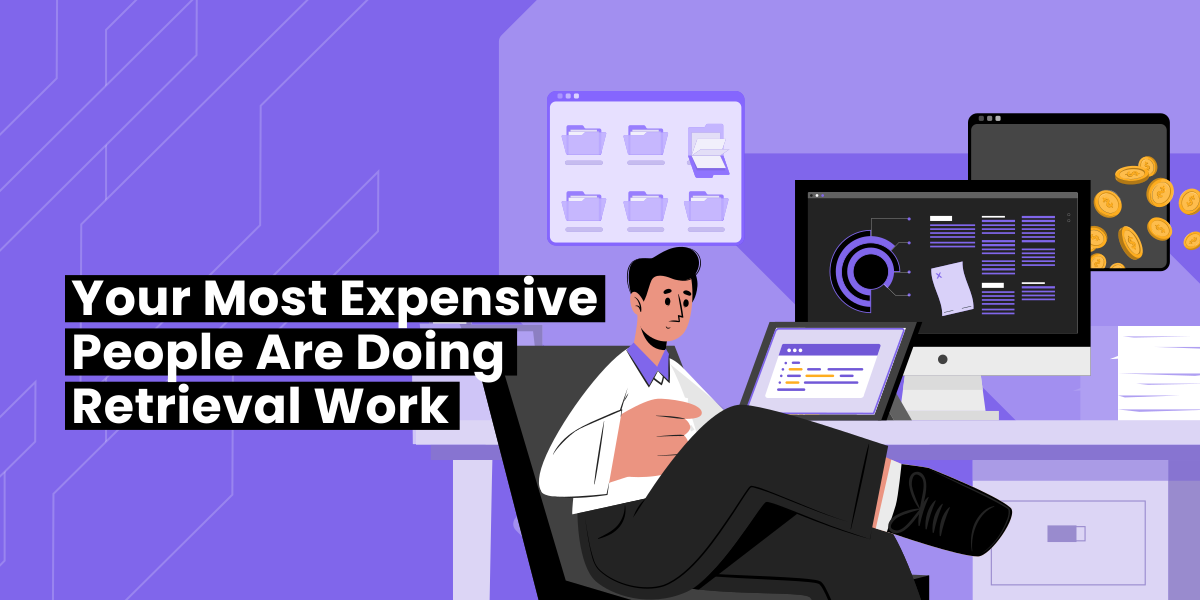
Watch what your most experienced people actually do all day. Most of it is not judgment. It is retrieval.
The estimator digging through old jobs to price a new one. The senior engineer answering the same architecture question for the fourth time this quarter. The account lead rebuilding a proposal from three past SOWs. The controller assembling the same month-end numbers from the same five systems. The support lead searching last year's tickets because she is the only one who remembers the fix.
These are your best people. You pay them for their judgment. And they spend most of their week finding things so they can spend a fraction of it judging.
I run a software firm that builds internal systems for mid-market companies, and this pattern shows up in every function we touch. When we sit with a team and break down where the hours in an expert task actually go, the split is remarkably consistent. Most of the work is locating what the company already knows. What did we do last time. What did it cost. What did we promise. Who decided, and why. The judgment — the part that genuinely needs that specific person — is the last stretch.
The Retrieval Is Invisible
The problem is that the retrieval is invisible. Nobody budgets for it. It does not show up on a timesheet as "archaeology." It just shows up as your senior people being busy, your turnaround times being long, and everything important waiting on one person's memory.
That last part is the real exposure. When the knowledge lives in someone's head and a folder structure only they understand, you do not own it. They do. Every quote, proposal, and fix that depends on their recall is a process with a single point of failure, and you find out how single it was the week they leave.
Retrieval Is Exactly the Shape of Problem AI Is Good At
Here is why I am writing about this now. Retrieval is exactly the shape of problem AI is genuinely good at today. Not the AI in the demos. Not a chatbot bolted onto your website. A system that reads the incoming request — whatever it is, an RFQ, a support ticket, a proposal ask — pulls from your own historical record, and produces a draft. Your expert opens a draft instead of a blank page. They fix what the system got wrong, apply the judgment that is actually theirs, and send it. The human still owns the answer. They just stop doing the digging.
We have built this pattern for quoting in manufacturing, where the fastest quote usually wins and the pricing logic lived in one estimator's head. If that sounds familiar, it is worth looking at what we built: the AI Quoting Accelerator puts this architecture to work specifically for manufacturing and field services teams. The same pattern also works for proposals in services firms, for support teams sitting on years of resolved tickets, for finance teams assembling reports from systems that do not talk to each other. Different departments, same shape. The request comes in, the answer mostly exists already, and a person spends days proving it.
The Real Tradeoffs
There are real tradeoffs here, and I want to be honest about them.
Your history has to be in shape first. If it is scattered across email threads, PDFs, and a shared drive nobody has cleaned since 2019, the first phase of this project is not AI. It is getting your own knowledge into a state a system can use. That work is unglamorous and it is also where the value is, because it is the same work that would protect you the day your expert resigns.
The system will get things wrong, especially early. That is why the expert approves everything and nothing goes out the door on autopilot. The goal is a strong draft, not an unsupervised employee.
It will not fix a broken process. If your proposals lose because your pricing is wrong, drafting them faster just loses faster.
But none of that changes the math. A draft in minutes instead of days means you respond while the customer is still deciding. Your senior people spend their hours on the work that actually requires them. And the knowledge that currently lives in one person's head becomes something the business owns.
The Exercise That Costs Nothing
Pick your most expensive person. Ask them to walk you through their last big deliverable, hour by hour. Mark every hour that was spent finding, assembling, or reconstructing something the company already knew. That number is usually a shock, and it is also your answer to the question every leadership team is asking right now — where should AI go first in your business.
Where does everything wait on one person's memory in your company? If a name came to mind before you finished the sentence, that is the project.


 Jul 8, 2026
 AI
AI
 AI
AI
 AI
AI