Ready to Work Together?
Let's discuss how our expertise can help transform your business.


 Apr 7, 2026
Every new AWS engagement at NextLink Labs used to start from scratch. Engineers assembled infrastructure from memory, past projects, or whatever pattern they had used most recently. The result was environments that worked but did not match each other, decisions that were not documented, and onboarding friction that slowed every handoff. This architecture was built for teams running containerized workloads on AWS: SaaS products, internal platforms, customer-facing APIs.
The Terraform reference architecture fixes that. It's a production-ready AWS foundation expressed entirely in reusable Terraform modules, covering the full stack from networking to application delivery. Any NextLink Labs engineer can pick it up, configure it for a specific client, and deploy it without rebuilding decisions that have already been made.
The same architecture runs NextLink Labs' own internal infrastructure. When we provision a new environment for our own tooling, we use the same modules we hand to clients. That consistency means issues surface in our environment before they reach a client's, and improvements we make internally ship back into the baseline.
The modules are layered. Networking and IAM are provisioned first. RDS and ElastiCache sit in a private tier with no public ingress. The EKS cluster runs in private subnets with a dedicated node group configuration. Traffic enters through CloudFront, terminates TLS, and applies edge caching before handing off to the ALB. The ALB routes by host and path rules to the appropriate Kubernetes services. Secrets Manager holds all credentials, with IAM role bindings that give EKS workloads scoped access at runtime through IRSA, so nothing is hardcoded.
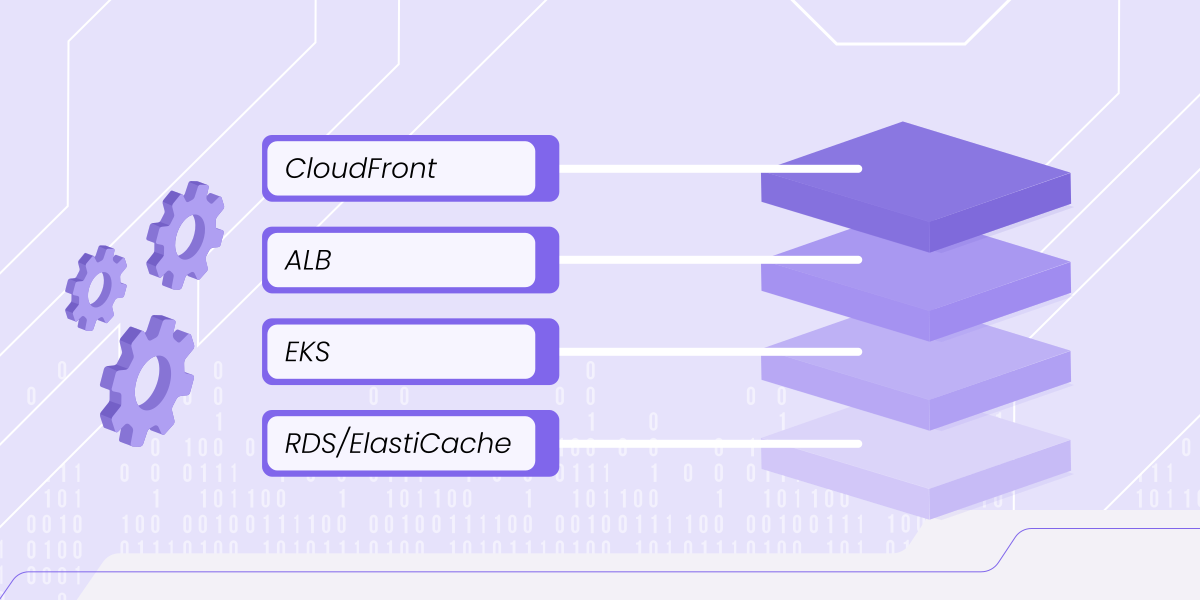
The design follows one rule: each layer is reachable only through the layer above it. A database is not reachable from the internet. A pod does not have blanket access to secrets it does not own. The practical effect is that a misconfiguration at one layer does not cascade down. A misconfigured ALB rule does not expose the database. A compromised pod does not get access to every secret in the account.
The things that vary across clients (instance sizes, replica counts, retention windows, CIDR ranges) are exposed as module inputs. Structural decisions are enforced at the module level. A new environment is a thin configuration file, a plan, and an apply.
Each new engagement that introduces a legitimate deviation from the baseline gets folded back into the module library, so the standard improves without a dedicated internal sprint.
Since the entire architecture is code, it versions like code. Every change goes through a pull request, gets reviewed, and is tagged. When a client asks why a particular decision was made six months ago, the answer is in the commit history. When NextLink Labs ships an improvement to the baseline, existing environments can pull it in as a deliberate upgrade rather than discovering the drift during an incident. That version history also makes audits straightforward: the state of the infrastructure at any point in time is reproducible from the repo.
Organizations that engage NextLink Labs for platform work get infrastructure validated across multiple production deployments. The Terraform code is handed over at the end of the engagement, readable by engineers who were not involved in building it, and extendable without understanding a proprietary framework. For requirements that go beyond the standard baseline (stricter compliance, multi-region active-active, custom network topology) NextLink Labs has extended it on live engagements and folded those patterns back into the library.
If you're evaluating your AWS infrastructure setup or looking for a platform engineering partner, we're happy to talk through what this looks like for your stack. Reach out to the NextLink Labs team at contact@nextlinklabs.com or visit nextlinklabs.com.
 DevOps
Learn how to add Grafana observability to any AWS Fargate service using a Grafana Alloy sidecar and a single Terraform module block — CPU, memory, network, and trace signals flowing in under five minutes.
 Aru Shanmugam
·
Jun 3, 2026
Aru Shanmugam
·
Jun 3, 2026
 DevOps
A Jenkinsfile with one stage, no scanning, no caching. Here's how NextLink Labs used Claude Code to rewrite it into a production GitLab pipeline with rootless BuildKit, Trivy scanning, Skopeo retag, and a proper DAG — in under an hour.
Alex Podobnik
·
Apr 28, 2026
 DevOps
Someone set that up manually a while back. Sound familiar? Here's how NextLink Labs uses Claude Code's agentic loop to import hand-built AWS infrastructure into Terraform — compressing a multi-day job into an afternoon.
Alex Podobnik
·
Apr 24, 2026
 DevOps
Most LLM-generated Terraform is bad — not because of the tool, but because of the prompt. Here's how NextLink Labs uses Claude Code and CLAUDE.md conventions to generate Terraform modules that are close to merge-ready.
Alex Podobnik
·
Apr 24, 2026